


A couple of weeks ago, I watched a friend perform with the Colorado Symphony Orchestra. Aside from my own brief classical music pursuits in middle school, I may have only seen a professional symphony perform once in my life as a preteen. Needless to say, it’s been a while.
I didn’t know what to expect, but the minute the orchestra struck its first chord, I had goosebumps all over my body. It caught me off guard because that middle school version of Nathalie who played the viola never quite felt like me. But as I sat in that darkened hall, I experienced a magical sense of wonder. I was awestruck watching dozens of musicians bent over instruments that have not materially changed in hundreds of years, reading notes that are their own language, producing sounds that no algorithm or interface could replicate with the same visceral charge.
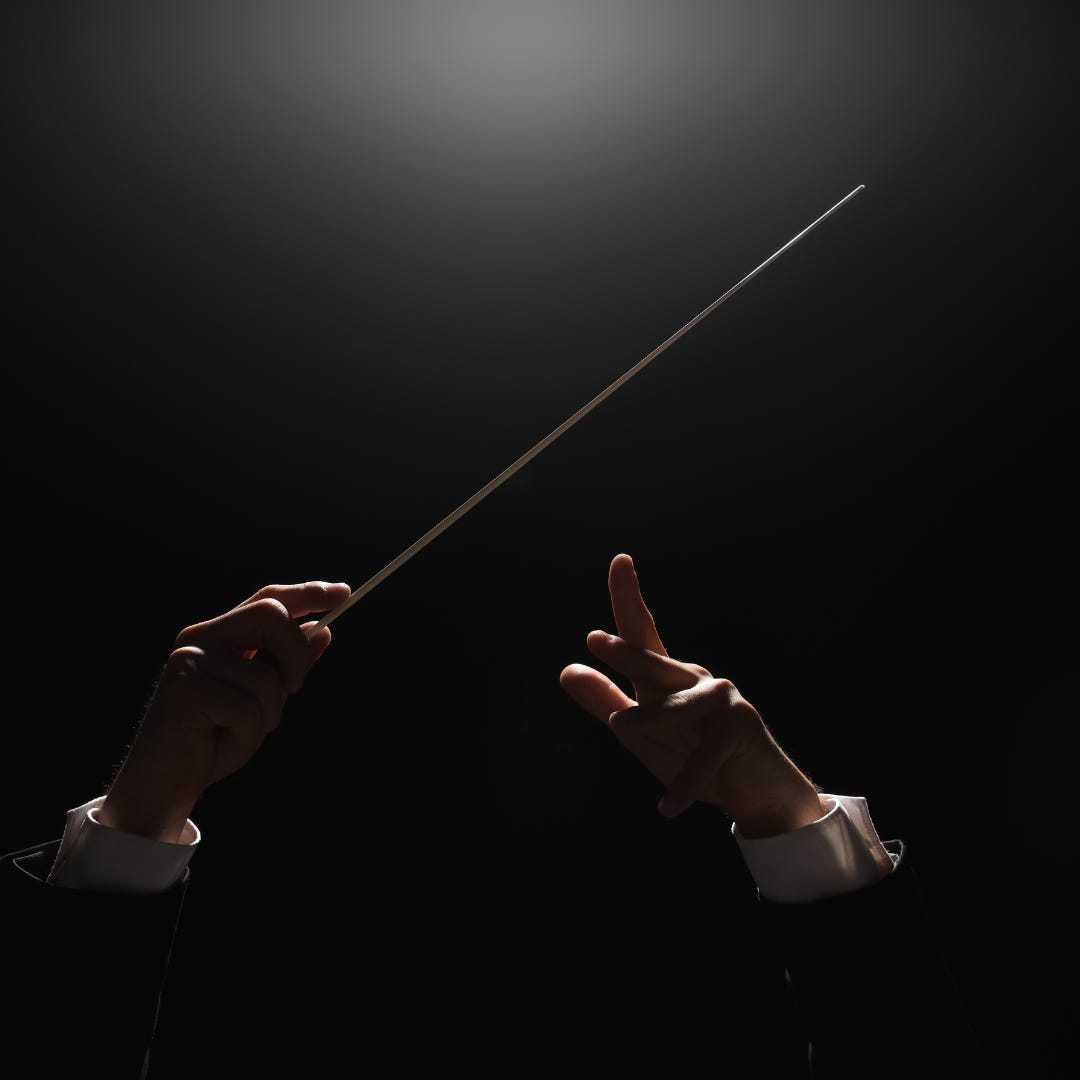
More than anything, I couldn’t take my eyes off the conductor. Having been to my fair share of ballets, I’ve vaguely noticed the conductor in the orchestra pit, waving his arms around madly, but without much of a second glance, much less any kind of reverence.
This time, I was transfixed watching someone whose entire role is to stand surrounded and slightly above a sea of instruments, wave a wand, and, as if by magic, weave the choreography of sound at precisely the right moment. How simple, and yet how beautifully complex. The musicians in their black attire; the unquestioning respect as the conductor made his way to the podium; the collective hush of an audience witnessing something that has been done this way for centuries, unchanging in the face of every social and technological advancement, every fear about artificial intelligence replacing what’s human, every cultural upheaval that insists the old ways are obsolete. And yet there I was, moved to my bones by an art form that has refused to evolve into something it isn’t.
I left that evening thinking about what’s True.
We live in a time where truth itself has become contested terrain: what’s real, what’s fake, what’s artificial and manufactured. Even the commonly thrown-around phrase “I’m speaking my truth” implies that it is a matter of personal interpretation. And of course, we have a right to our experience, our meaning, and the impact we carry from the things we’ve lived through. That is subjective and sacred and ours. But Truth, with a capital T, is something else entirely.
Truth is all-inclusive. It is that which applies universally to all things, all the time. It exists beyond narratives, judgments, and contradiction. It is what remains when you strip away every story you’ve told yourself about who you are, every fear you’ve accumulated, every identity you’ve borrowed from someone else’s expectations. And if I’m being precise about the quality of it, Truth is that which is most in flow, simplest in function, and most expansive in essence.
Which is exactly what I witnessed in that concert hall.
The conductor wasn’t striving. He wasn’t trying to prove his relevance or assert his power. He was simply flowing, weaving something alive out of the raw materials of vibration and silence, tension and release. There was nothing to add and nothing to subtract. The whole thing worked because it was Truth expressed by way of this creative art form.
One of my mentors, from whom I also learned this definition and reference point of Truth, says that life is a game of limitation. We are here to remember the Truth of who we are as we constantly meet our edges and expand beyond them. I keep returning to this idea because it reframes so much of what we experience as struggle into something more purposeful. The fear, the self-doubt, the narratives we build around why we can’t or shouldn’t or aren’t ready; these are the edges. They are the places where limitation meets the part of us that knows, underneath all of it, that we are more than what we’ve been conditioned to believe. We have the capacity to make beautiful music of our lives in our own unique way. What is True in us is everything that lives and thrives beyond those limitations.
And here is where the symphony becomes more than a beautiful evening out. Because the invitation, as I sat in that audience feeling something ancient and wordless move through me, is the same invitation that meets us in every experience: to step onto the podium of our own lives and simply begin. To trust that the music is already written, that the instruments are already tuned, and that our role is not to control every note but to flow with what wants to emerge. To live the authentic embodiment of our fullest self-expression, and in doing so, be the conductors of the life that is already moving through us.
“Truth is all-inclusive. It is that which applies universally to all things, all the time.”
Beautiful and true…..thank you Nathalie