


It’s all perfect. That was the message delivered directly into my soul during a breath work session, as I lay on the floor of a retreat center in Costa Rica in the spring of 2024. I had gone with the intention of sitting once again with grandmother Ayahuasca, alongside my then-coach and a small group of fellow seekers. This was my third plant medicine retreat since ending my marriage, and since my mother’s cancer diagnosis and her all-too-swift departure from this life. The mix of regret and emptiness inside me had turned into a quest to find every broken place in myself and extract it in the most intense, confronting way possible. Feeling the acute pain of being human, the guilt, the loss, the yearning, I told myself that purging it must be proof that my healing was working.
Yet the day of the first ceremony, my body decided otherwise: my period started unexpectedly, and out of respect for the guidelines of this particular indigenous tradition, I couldn’t participate. Having prepared for months and traveled all the way to Costa Rica, the isolation from the rest of the group was harder to sit with than the Ayahuasca. The irony wasn’t lost on me: the fertility “problem” (among others) I’d come there hoping to heal was the very thing keeping me out of the ceremony. Instead, I watched my peers retreat each evening and re-emerge the next morning, sharing their trip reports. Even though this turn of events gave me a softer, more beautiful alternative ceremony of my own, the old patterns of comparison and the dreaded FOMO still crept in. This wasn’t on the figurative brochure.
That same tension—wanting to belong to the group and, somewhere underneath it, wanting my own singular ceremony—is one I recognize from the rest of my life too. On paper, I followed a fairly traditional path: good girl, good school, good grades. But in my first job out of college, the rug was pulled out from under me in an unexpected layoff after eighteen months of relentless work and stress. My soul leaned into the detour. I pursued a role with a company that served only Latin America as one of a handful of non-Latin employees on staff. A few years later, that position led to the chance to move to Argentina and then to Mexico, as a young, naive gringa leading teams in a foreign language on unfamiliar terrain. In retrospect, the early professional divergence revealed as much to me about my own psyche as any plant medicine ceremony has: an internal tug-of-war between wanting to take the road less traveled, to step outside the mold, and wanting the conventional path, the one where I fit neatly inside it. Both desires have always lived in me at once, and I’ve never fully surrendered to either.
That inner battle took up arms again recently while I was home visiting family. Holding my cousin’s six-week-old baby, I watched him and his wife move through new parenthood together in their early thirties, both with good jobs, a house, and a partnership that from where I sat looked effortless and exactly on schedule. Why not me? Why did I take the life detour? I felt a familiar ache, and the old story returned: that I’m behind, that I did things wrong, that there’s still something in me to heal and fix. Being single and forty, just starting on my entrepreneurial path: that wasn’t in the brochure either.
A passage from one of my favorite authors, Neale Donald Walsch, has helped me make sense of the message I heard so clearly in Costa Rica. In his book Happier Than God, he writes that calling a condition “perfect” is not the same as calling it “wonderful.” It is to say that it’s ideally suited to your soul’s agenda in this moment, which may very well be to change the condition as a means of knowing, demonstrating, and experiencing the vastness of Who You Really Are. He says: “It is therefore very okay to observe previously created conditions, circumstances, or possibilities that do not please you, to take responsibility for your role in co-creating them, to speak a word of gratitude for their existence, and then to choose again, creating another condition or circumstance without judgment or condemnation.”
Something clicked when I read this. It hasn’t eliminated the tension I feel between checking the boxes of a “normal” life and being the one who goes her own way, often by myself, but it has put that tension into context. It’s all perfect, I suppose, if I’m open to receiving what it offers. I liked that idea enough to tattoo it on my arm last year: a permanent reminder that, at some level, I am always choosing in alignment with the lessons I’m here to learn, and to trust my inner guidance system.
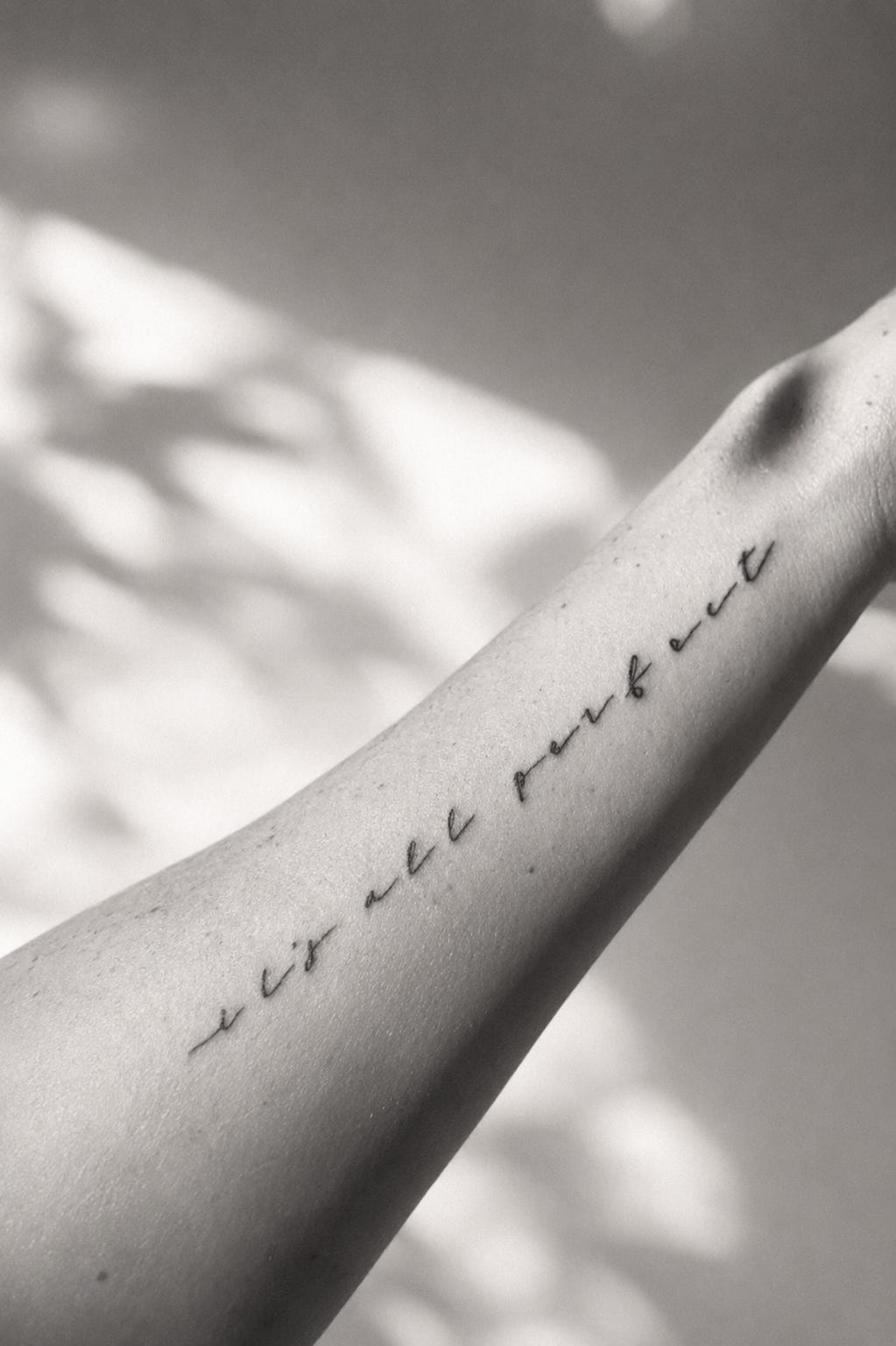
Reaching what many call “mid-life,” seeking an epic love, building my own business after detonating my corporate career, feeling behind, left out, comparing, questioning the whole thing: it’s all perfect. I want the partnership. I want to stop doing math on my own timeline every time I hold someone else’s baby. And in the same breath, I love the life I’m building. I love that my work is a creative act—an expression of my values and purpose. I love being a bridge between cultures, and between the linear corporate world and the esoteric, emotional, and energetic domains. Feeling beautifully, sometimes painfully, alone on my path: also perfect. The loneliness and the freedom live in the same body. So does the fear of missing out. So does the quieter, stubborn certainty underneath it all, that I haven’t.
I know that everything I desire, and plenty that I don’t, is on its way right on time. I am choosing it, after all. And I know that I am here to create the kind of life that was never going to fit neatly into any brochure. I imagine none of it will look remotely like what I expected. And that, too, is all perfect.